In today’s data-driven business environment, organizations depend on reliable tools to move, transform, and manage information across multiple systems. SQL Server Integration Services (SSIS) is one of Microsoft’s most trusted platforms for enterprise data integration. It helps businesses automate complex ETL (Extract, Transform, Load) processes with speed and accuracy.
The term “SSIS-469” is often linked to package execution issues, workflow optimization, and advanced integration practices.
Understanding SSIS-469 improves performance, reduces errors, and streamlines data operations across system migrations, data warehouses, and business intelligence projects.This guide covers its architecture, capabilities, troubleshooting methods, optimization strategies, security features, and real-world applications in detail.
What Is SSIS-469?
SSIS-469 is commonly discussed in relation to SQL Server Integration Services environments where organizations manage automated data movement, transformation, and workflow execution. While many users encounter the term during troubleshooting or package management activities, the broader discussion centers around SSIS itself and its role in enterprise data integration.
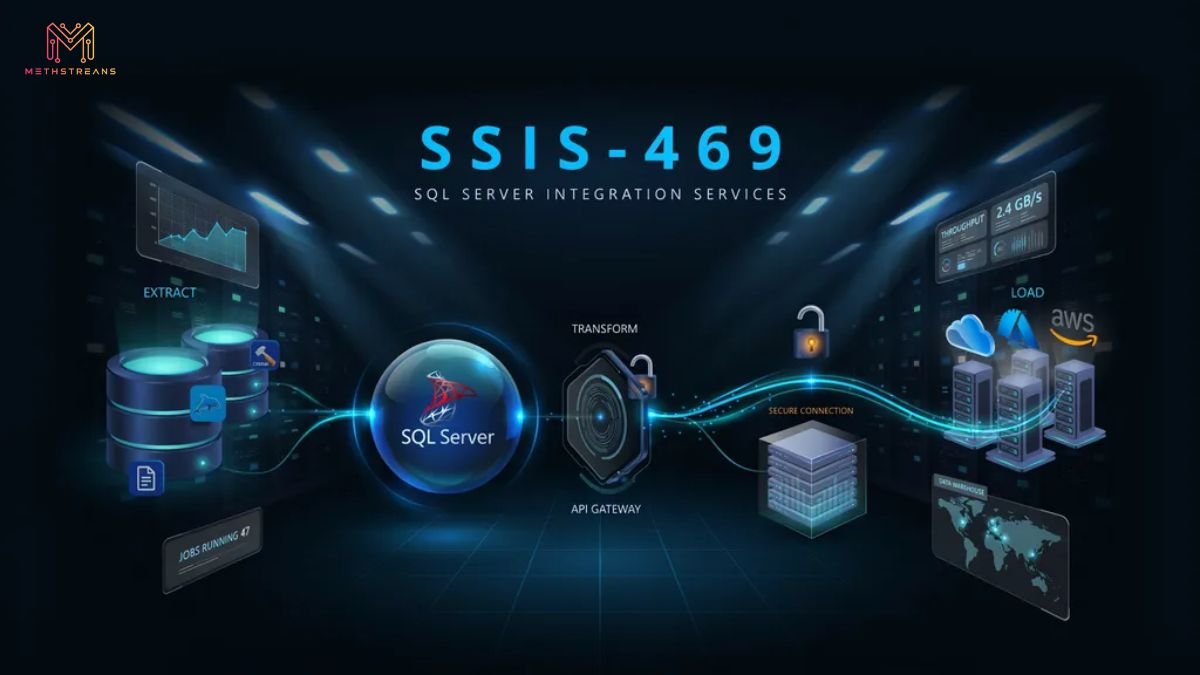
At its core, SSIS enables businesses to extract data from multiple sources, transform it according to business requirements, and load it into target systems such as data warehouses, reporting databases, cloud platforms, or analytics solutions. Unlike manual processes or custom scripts that require extensive coding, SSIS provides a visual development environment that simplifies package creation while maintaining scalability and performance.
Its ability to connect databases, flat files, APIs, cloud services, and legacy systems makes it an essential technology for organizations seeking consistent, reliable, and automated data workflows.
Understanding the Architecture of SSIS-469
The architecture behind SSIS is designed to support both flexibility and performance. Control Flow acts as the orchestration layer that determines how tasks are executed throughout a package. Through conditions, dependencies, and workflow logic, it ensures that processes run in the correct sequence while supporting parallel execution when appropriate.
Data Flow acts as the processing engine that extracts, transforms, validates, and delivers data to its destination. SSIS processes these operations in memory, which allows it to handle large datasets efficiently with minimal performance overhead.
Connection Managers simplify connectivity by centralizing database, file, and cloud service configurations. This approach reduces maintenance complexity while improving deployment consistency across development, testing, and production environments.
Variables, parameters, event handlers, and logging mechanisms add additional flexibility by enabling dynamic package behavior, automated error responses, and detailed monitoring throughout the execution lifecycle.
Key Features of SSIS-469
One of the primary reasons organizations continue to rely on SSIS is its ability to automate repetitive data integration tasks while maintaining high levels of reliability. The platform supports large-scale data processing through optimized memory management and efficient execution engines, allowing businesses to handle growing volumes of information without sacrificing performance.
SSIS also provides advanced error-handling capabilities that help prevent workflow failures from disrupting critical operations. Through checkpoints, logging systems, and recovery mechanisms, teams can identify and resolve issues quickly while minimizing downtime.
Another significant advantage is scalability. Whether operating in traditional on-premises environments or hybrid cloud infrastructures, SSIS can adapt to evolving business requirements while maintaining consistent performance. Combined with strong security controls, role-based access management, and package encryption, it offers a dependable foundation for enterprise-grade data integration.
How SSIS-469 Works
The process begins by collecting information from various sources through specialized connectors designed to minimize system impact and maximize efficiency. Once the data is extracted, transformation components apply business rules that cleanse, standardize, enrich, and restructure information according to organizational requirements.
Before data reaches its destination, validation mechanisms verify quality standards and identify potential inconsistencies that could affect reporting or analytics. After successful validation, the processed data is loaded into target systems using optimized loading techniques designed to improve throughput and reduce execution times.
Throughout this process, the SSIS runtime engine manages resources, monitors execution, and records detailed operational information that supports troubleshooting and performance analysis.
Benefits of Using SSIS-469
Organizations that implement SSIS effectively often experience significant improvements in operational efficiency and data quality. Automation reduces manual intervention, minimizing the risk of human error while accelerating data delivery across departments.
Because information is transformed and validated consistently, decision-makers gain access to more accurate reporting and analytics. This improved reliability helps organizations make faster, more informed business decisions based on trustworthy data.
SSIS also delivers long-term cost benefits by reducing custom development requirements and simplifying maintenance efforts. As data volumes continue to grow, its scalable architecture allows organizations to expand operations without proportionally increasing administrative complexity.
Common Causes of SSIS-469 Errors and Their Solutions
Most SSIS-related issues originate from connectivity problems, configuration inconsistencies, resource limitations, permission restrictions, or data compatibility conflicts. Small changes to source systems, destination schemas, or environment settings can often trigger package failures if not properly managed.
Successful troubleshooting starts with verifying connection settings, reviewing package configurations, validating data mappings, and examining execution logs. Detailed monitoring frequently reveals the root cause of failures, enabling administrators to implement targeted fixes rather than relying on trial-and-error approaches.
Regular updates, proper deployment practices, and proactive performance monitoring further reduce the likelihood of recurring issues while improving overall system stability.
Performance Optimization Best Practices
High-performing SSIS environments are built on efficient design principles. Removing unnecessary columns early in the process, optimizing source queries, reducing transformation complexity, and carefully managing buffer allocations can dramatically improve execution speed.
Organizations handling large datasets often benefit from parallel processing techniques that allow multiple operations to run simultaneously. Combined with incremental loading strategies and efficient lookup configurations, these optimizations help reduce processing times while maximizing available hardware resources.
Performance tuning should be viewed as an ongoing process rather than a one-time activity, especially in environments where data volumes and business requirements continue to evolve.
Security and Compliance Considerations
Protecting sensitive information is a critical requirement for modern data integration platforms. SSIS supports multiple security layers, including encryption, access controls, credential protection, and audit logging to help organizations safeguard valuable data assets.
These capabilities not only improve security but also support compliance initiatives by providing transparency, traceability, and accountability throughout the data lifecycle. As regulatory requirements continue to expand, strong governance practices become increasingly important for maintaining organizational trust and operational integrity.
Real-World Applications of SSIS-469
Across industries, SSIS plays a vital role in supporting data-driven operations. Financial institutions use it to automate reporting and regulatory processes, healthcare organizations rely on it for secure data integration, and retailers leverage it to consolidate information from multiple sales channels.
Business intelligence platforms, cloud migration projects, enterprise reporting systems, and large-scale data warehouses all benefit from SSIS’s ability to manage complex workflows efficiently while maintaining high standards of accuracy and reliability.
Future of SSIS-469
As enterprise data ecosystems become increasingly complex, Microsoft continues to enhance SSIS through deeper cloud integration, improved monitoring capabilities, stronger security frameworks, and AI-assisted data management features. These developments position SSIS to remain relevant as organizations adopt hybrid architectures and modern analytics platforms.
The growing demand for faster insights, better governance, and scalable integration solutions ensures that SSIS will continue playing an important role in enterprise data strategies for years to come.
Conclusion
SSIS-469 represents an important area of discussion within the broader SQL Server Integration Services ecosystem. Understanding SSIS architecture, automation, optimization techniques, and security practices helps organizations build efficient and reliable data integration workflows. It supports data warehousing, cloud migration, business intelligence, and enterprise reporting by turning raw data into usable insights. Proper implementation improves data quality, boosts operational efficiency, and supports better decision-making in data-driven environments.
FAQs
What is SSIS-469?
SSIS-469 relates to SQL Server Integration Services environments, data integration workflows, and package execution management.
What is SSIS used for?
SSIS extracts, transforms, and loads (ETL) data between databases, files, cloud platforms, and business applications.
What causes SSIS-469 errors?
Common causes include connection failures, configuration issues, permission restrictions, and data type mismatches.
How can I improve SSIS performance?
You can improve performance by optimizing queries, reducing unnecessary transformations, using parallel processing, and managing buffer settings efficiently.
Is SSIS suitable for large enterprises?
Enterprises widely use SSIS for data warehousing, BI, cloud migration, and large-scale data integration.