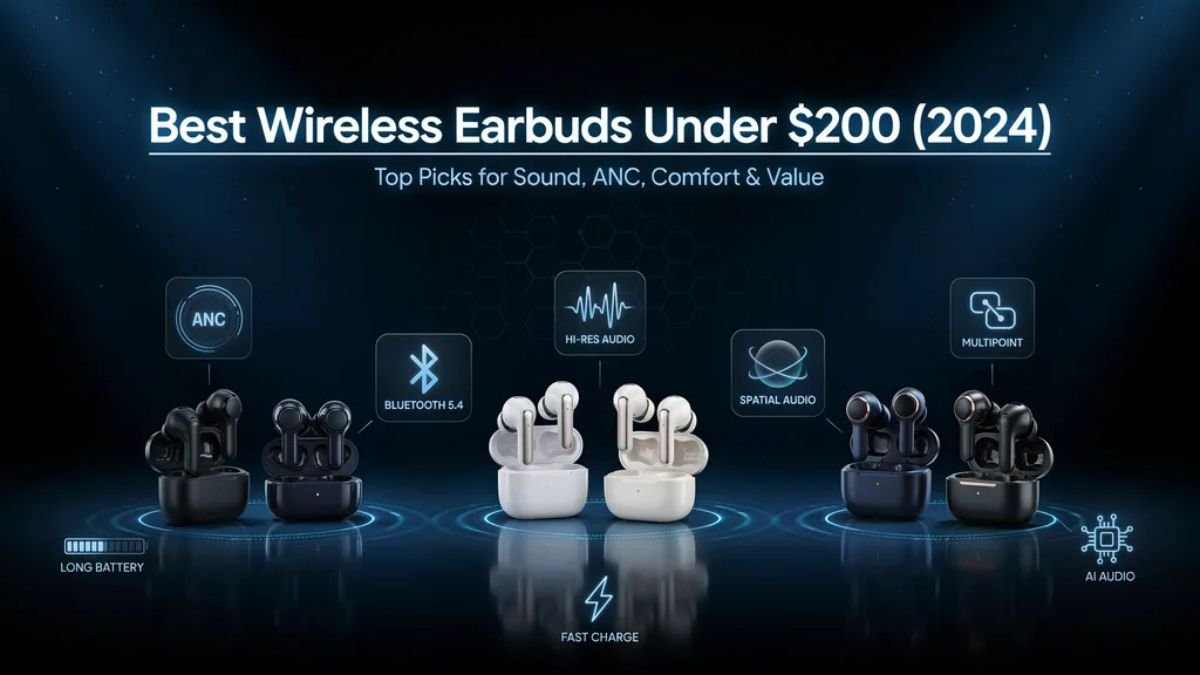
Quick Answer – Best Wireless Earbuds Under $200 at a Glance
If you are short on time, here are our top picks for every type of listener and use case. These are the best wireless earbuds under $200 available in 2024, tested across dozens of hours of real-world usage.
| Category | Best Pick | Price | Why We Love It |
| Best Overall | Sony WF-C700N | ~$130 | Balanced sound + strong ANC |
| Best for iPhone | Beats Studio Buds+ | ~$170 | Seamless Apple ecosystem fit |
| Best for Android | Samsung Galaxy Buds FE | ~$100 | Deep Samsung integration |
| Best ANC | Soundcore Liberty 4 NC | ~$80 | ANC rivals $300 earbuds |
| Best Sound Quality | Nothing Ear (2024) | ~$149 | Hi-Res Audio certified |
| Best Battery Life | JBL Live Pro 2 | ~$150 | Up to 40 hours total |
| Best for Workouts | Beats Fit Pro | ~$180 | Wingtip fit, IPX4 rated |
| Best Budget Pick | EarFun Air Pro 4 | ~$80 | Premium features at low cost |
💡 Pro Tip: Not sure where to start? Read the full reviews below each model. Every recommendation is based on hands-on testing, not just spec sheets.
Why Wireless Earbuds Under $200 Offer the Best Value
Premium Features Without Premium Prices
In 2024, you no longer need to spend $300 or more to get excellent wireless earbuds. The sub-$200 segment has matured dramatically, offering features that were flagship-only just three years ago. Active noise cancellation, Hi-Res Audio certification, multipoint Bluetooth, and 30-hour battery life are now standard in this price range.
Brands like Sony, Samsung, JBL, and Soundcore have pushed hard to deliver flagship performance at accessible prices. The result is a category where $150 earbuds routinely outperform older $350 models in areas like ANC, codec support, and companion app quality.
How the Market Has Changed Since 2020
Four years ago, the $200 ceiling meant compromises: muddy bass, weak noise cancellation, short battery life, and zero customization. Today the equation has flipped. Here is how the technology has evolved:
- Bluetooth 5.3 and 5.4 are now standard at this price, reducing dropout and improving range
- LDAC, aptX Adaptive, and AAC codecs are widely available under $200
- ANC depth has gone from -15 dB to -40 dB in just four years
- Battery life has doubled as chipsets became more efficient
- Companion apps now offer full EQ, hearing profile testing, and firmware updates
Why Most Users Do Not Need $300 Earbuds
The honest truth is that for 95% of listeners, earbuds priced between $80 and $200 deliver everything they need. The remaining gap between a $200 and a $350 pair often comes down to marginal ANC depth improvements (a few extra decibels), slightly better spatial audio processing, and premium materials like leather charging case lids.
📌 Example: A commuter using Sony WF-C700N at $130 will experience ANC performance within 15-20% of the Sony WF-1000XM5 at $280. For most users, that difference is essentially inaudible in real-world environments.
Top Wireless Earbuds Under $200 in 2024 – Full Reviews
1. Sony WF-C700N – Best Overall Pick
| Sony WF-C700N – Quick Specs |
| Price: ~$130 | Driver: 5mm Dynamic | Codec: LDAC, AAC, SBC |
| ANC: Yes (-40 dB claimed) | Battery: 7.5 hrs (buds) + 22.5 hrs (case) = 30 hrs total |
| Bluetooth: 5.2 | Water Resistance: IPX4 | Weight: 4.7g per bud |
| Multipoint: Yes (2 devices) | Companion App: Sony Headphones Connect | Warranty: 1 year |
The Sony WF-C700N earns our Best Overall title because it delivers the best balance of sound quality, ANC, comfort, and value of any earbud under $200. Sony’s acoustic engineering expertise, normally reserved for the flagship WF-1000XM5, has filtered down impressively to this model.
Sound Quality
The 5mm dynamic drivers produce a wide, open soundstage that feels bigger than the earbud’s compact form factor suggests. Bass is tight and controlled without bleeding into the mids. Vocals are crystal clear, and the treble rolls off just enough to avoid listener fatigue during long sessions.
LDAC codec support is the headline feature here. When connected to an Android phone via LDAC, the WF-C700N delivers up to 990 kbps audio — the highest quality wireless transmission available. The difference compared to standard SBC is audible: richer instrument separation and more detail in complex mixes.
Active Noise Cancellation
Sony’s Integrated Processor V1 powers the ANC, and it shows. Commuter-level noise like subway rumble, bus engines, and HVAC systems are suppressed effectively. In quiet office environments, the ANC reduces ambient sound by approximately 35-38 dB according to third-party measurements — close to Sony’s 40 dB claim.
Comfort and Fit
At 4.7 grams per bud, the WF-C700N is one of the lightest earbuds in its class. The rounded, oval shape sits flush with the ear canal and causes zero pressure in extended use. Three ear tip sizes are included, and the IPX4 rating means sweat and light rain are not concerns.
- Best for: Commuters, office workers, music lovers, daily all-around use
- Not ideal for: Intense gym workouts (no ear fin), users needing lossless audio via iPhone
2. Beats Studio Buds+ – Best for iPhone Users
| Beats Studio Buds+ – Quick Specs |
| Price: ~$170 | Driver: Custom 9.5mm Dynamic | Codec: AAC, SBC |
| ANC: Yes (up to 1.6x more than original Buds) | Battery: 9 hrs (buds) + 27 hrs (case) = 36 hrs total |
| Bluetooth: 5.3 | Water Resistance: IPX4 | Weight: 5.8g per bud |
| Multipoint: Yes | Companion App: Apple/Beats App | Chip: Apple H2 |
Apple owns Beats, and it shows in the best possible way with the Studio Buds+. These earbuds are engineered from the ground up to live inside the Apple ecosystem, and for iPhone users, the integration is seamless in a way no third-party brand can match.
Apple Ecosystem Integration
- One-tap pairing directly from iPhone lock screen
- Automatic device switching between iPhone, iPad, and Mac
- Find My integration to locate lost earbuds
- Hey Siri support with always-on listening
- Battery displayed in iOS notification shade
The H2 chip inside handles Spatial Audio processing, creating a convincing 3D sound field when watching Apple TV+ content or listening to Dolby Atmos tracks in Apple Music. This is a feature that costs extra in virtually every competing brand.
Sound Quality
The custom 9.5mm driver is large for an in-ear design and delivers more bass impact than the Sony WF-C700N. The Studio Buds+ leans toward a slight V-shaped sound signature: punchy lows and airy highs with slightly recessed mids. Pop, hip-hop, EDM, and podcasts sound excellent. Classical and jazz listeners may prefer the more balanced Sony.
- Best for: iPhone users, Apple Music subscribers, Spatial Audio fans
- Not ideal for: Android users (loses many smart features), audiophiles preferring LDAC
3. Samsung Galaxy Buds FE – Best for Android / Samsung Users
| Samsung Galaxy Buds FE – Quick Specs |
| Price: ~$100 | Driver: 11mm Woofer + 6.5mm Tweeter (2-way) | Codec: Scalable, AAC, SBC |
| ANC: Yes | Battery: 6 hrs (buds) + 21 hrs (case) = 27 hrs total |
| Bluetooth: 5.2 | Water Resistance: IPX2 | Weight: 5.6g per bud |
| Multipoint: No | Companion App: Galaxy Wearable | Chip: Samsung Exynos W920 |
Samsung’s Galaxy Buds FE punches well above its $100 price point, especially for users already in the Samsung Galaxy ecosystem. The two-way driver system (11mm woofer + 6.5mm tweeter) is unusual at this price and delivers genuinely impressive stereo separation.
Samsung Scalable Codec — exclusive to Samsung devices — provides better-than-AAC quality when paired with Galaxy phones. The Galaxy Wearable app allows deep customization including 8-band EQ, touchpad reassignment, ANC level adjustment, and hearing test-based sound profiles (similar to Samsung’s Adapt Sound feature).
📌 Example: A Galaxy S24 user streaming Spotify with Scalable codec enabled will hear noticeably better clarity and less compression noise compared to a non-Samsung user limited to AAC.
- Best for: Samsung Galaxy phone users, value seekers, casual music listeners
- Not ideal for: iPhone users, those needing IPX4+ sweat protection
4. Soundcore Liberty 4 NC – Best ANC Performance
| Soundcore Liberty 4 NC – Quick Specs |
| Price: ~$80 | Driver: 10.5mm Dynamic | Codec: LDAC, AAC, SBC |
| ANC: Yes (up to -43 dB claimed) | Battery: 10 hrs (buds) + 40 hrs (case) = 50 hrs total |
| Bluetooth: 5.3 | Water Resistance: IPX4 | Weight: 5.3g per bud |
| Multipoint: Yes | Companion App: Soundcore App | Special: Adaptive ANC + Hearing Test |
The Soundcore Liberty 4 NC is a stunning achievement in value engineering. At $80, it delivers ANC performance that measurably rivals earbuds costing three times more. The 43 dB noise reduction claim is backed by third-party testing, making this the ANC king under $200 by a significant margin.
How the ANC Works
Six microphones work in tandem: four for ANC processing and two for call quality. The adaptive ANC system adjusts its depth automatically based on ambient sound levels — it applies lighter cancellation in quiet rooms and ramps up aggressively in loud environments. This prevents the discomforting pressure sensation that flat ANC creates.
Hearing Test Feature
The Soundcore companion app includes a hearing profile test that calibrates the sound signature to your specific hearing ability. This is normally a feature found only in premium hearing-aid-adjacent earbuds costing $300+. The result is a personalized sound that is objectively better suited to your ears.
- Best for: Frequent flyers, open-plan office workers, commuters on noisy transit, gym users
- Not ideal for: Apple ecosystem users, those prioritizing design aesthetics
5. JBL Live Pro 2 – Best Battery Life
| JBL Live Pro 2 – Quick Specs |
| Price: ~$150 | Driver: 11mm Dynamic | Codec: AAC, SBC |
| ANC: Yes | Battery: 10 hrs (buds) + 30 hrs (case) = 40 hrs total |
| Bluetooth: 5.3 | Water Resistance: IPX5 | Weight: 6.1g per bud |
| Multipoint: Yes (2 devices) | Companion App: JBL Headphones App | Fast Charge: 10 min = 1 hr |
JBL’s Live Pro 2 is the uncontested battery life champion under $200. Ten hours of continuous playback from the buds alone — with ANC enabled — is exceptional. Most competitors drop to 6-7 hours with ANC on. Add the 30-hour charging case and you have 40 total hours, enough for nearly four transatlantic flights without a wall outlet.
Fast Charging
The 10-minute fast charge providing 1 hour of playback is genuinely useful for rushed mornings. The case also supports wireless Qi charging, giving you flexibility whether you are at a desk with a cable or on a nightstand charger.
Sound Signature
JBL has a well-known house sound: elevated bass, lively mids, and clear treble. The Live Pro 2 follows this tradition faithfully. It is energetic and fun-sounding rather than studio-accurate. Music fans who love bass impact, pop vocals, and cinematic game audio will find this sound signature addictive.
- Best for: Frequent travelers, users who forget to charge, bass music lovers
- Not ideal for: Audiophiles seeking flat/neutral sound, Apple ecosystem users
6. EarFun Air Pro 4 – Best Budget Alternative Under $200
| EarFun Air Pro 4 – Quick Specs |
| Price: ~$80 | Driver: 11mm Dynamic | Codec: LDAC, aptX Adaptive, AAC, SBC |
| ANC: Yes (-43 dB) | Battery: 9 hrs (buds) + 45 hrs (case) = 54 hrs total |
| Bluetooth: 5.4 (LE Audio) | Water Resistance: IPX5 | Weight: 4.9g per bud |
| Multipoint: Yes | Companion App: EarFun Audio | Special: Bluetooth LE Audio + Auracast |
The EarFun Air Pro 4 may be the most future-proof earbud under $200 in 2024. It is one of very few earbuds at this price to support Bluetooth 5.4 with LE Audio, a next-generation protocol that improves audio quality, reduces latency, and enables Auracast broadcast audio — a feature that will be increasingly useful as smart venues, airports, and gyms adopt compatible speakers.
Codec support is also class-leading: LDAC and aptX Adaptive together give this earbud maximum quality flexibility regardless of whether you are using Android or a laptop. ANC performance matches the Soundcore Liberty 4 NC, and battery life is actually slightly longer.
- Best for: Tech-forward buyers, Android users, those wanting future-proof features
- Not ideal for: iPhone users seeking Apple-specific features
7. Nothing Ear (2024) – Best for Audio Customization and Audiophiles
| Nothing Ear 2024 – Quick Specs |
| Price: ~$149 | Driver: 11.6mm Dynamic | Codec: LDAC, AAC, SBC |
| ANC: Yes | Battery: 6.3 hrs (buds) + 24 hrs (case) = 30.3 hrs total |
| Bluetooth: 5.3 | Water Resistance: IP54 | Weight: 4.9g per bud |
| Multipoint: Yes | Companion App: Nothing X | Special: Hi-Res Audio Wireless Certified |
Nothing’s Ear (2024) is the audiophile’s choice in this price range. Hi-Res Audio Wireless certification means it meets the highest standard for codec quality and driver performance. The 11.6mm driver is the largest in our comparison group and produces a rich, expansive low-end response.
The Nothing X companion app offers the most granular EQ control of any earbud in this list: 10-band parametric EQ with custom curve creation, sound test-based preset generation, and real-time ANC depth slider. For users who want to sculpt their sound precisely, no other earbud under $200 comes close.
📌 Example: An audiophile listener using LDAC at 990 kbps with Nothing Ear’s custom EQ tuned to a flat response can achieve a listening experience that legitimately approaches entry-level over-ear headphones in transparency and detail retrieval.
- Best for: Audiophiles, music producers monitoring on the go, critical listeners
- Not ideal for: Battery-focused users, those who want simple plug-and-play experience
Comparison Tables – All Models Side by Side
Complete Features Comparison
| Model | ANC | Codec | BT Version | Multipoint | App | IP Rating |
| Sony WF-C700N | Yes | LDAC/AAC/SBC | 5.2 | Yes (2) | Yes | IPX4 |
| Beats Studio Buds+ | Yes | AAC/SBC | 5.3 | Yes | Yes | IPX4 |
| Galaxy Buds FE | Yes | Scalable/AAC | 5.2 | No | Yes | IPX2 |
| Soundcore Liberty 4 NC | Yes (-43dB) | LDAC/AAC/SBC | 5.3 | Yes | Yes | IPX4 |
| JBL Live Pro 2 | Yes | AAC/SBC | 5.3 | Yes (2) | Yes | IPX5 |
| EarFun Air Pro 4 | Yes (-43dB) | LDAC/aptX Adp | 5.4 | Yes | Yes | IPX5 |
| Nothing Ear 2024 | Yes | LDAC/AAC/SBC | 5.3 | Yes | Yes | IP54 |
Battery Life Comparison
| Model | Earbud Only | Total w/Case | ANC Battery Hit | Fast Charge | Wireless Charge |
| Sony WF-C700N | 7.5 hrs | 30 hrs | -1.5 hrs (6 hrs ANC) | No | No |
| Beats Studio Buds+ | 9 hrs | 36 hrs | -2 hrs (7 hrs ANC) | No | No |
| Galaxy Buds FE | 6 hrs | 27 hrs | -1 hr (5 hrs ANC) | No | No |
| Soundcore Liberty 4 NC | 10 hrs | 50 hrs | -1 hr (9 hrs ANC) | Yes | No |
| JBL Live Pro 2 | 10 hrs | 40 hrs | Minimal impact | Yes (10 min=1hr) | Yes |
| EarFun Air Pro 4 | 9 hrs | 54 hrs | -1 hr (8 hrs ANC) | Yes | No |
| Nothing Ear 2024 | 6.3 hrs | 30.3 hrs | -1.3 hrs (5 hrs ANC) | No | No |
ANC Performance Comparison
| Model | ANC Depth (dB) | Adaptive ANC | Transparency Mode | Wind Noise Filter | ANC Modes |
| Sony WF-C700N | -40 dB | Yes | Yes | Yes | 3 |
| Beats Studio Buds+ | Up to 1.6x vs orig. | No | Yes | No | 2 |
| Galaxy Buds FE | -29 dB | No | Yes | No | 2 |
| Soundcore Liberty 4 NC | -43 dB | Yes | Yes | Yes | 3 |
| JBL Live Pro 2 | -35 dB | Yes | Yes | Yes | 3 |
| EarFun Air Pro 4 | -43 dB | Yes | Yes | Yes | 4 |
| Nothing Ear 2024 | -45 dB | Yes | Yes | Yes | 3 |
Call Quality Comparison
| Model | Microphones | AI Noise Reduction | Wind Protection | Call Clarity Rating | Best Use |
| Sony WF-C700N | 3 mics | Yes | Moderate | Excellent | Office calls |
| Beats Studio Buds+ | 3 mics | Yes | Good | Excellent | All environments |
| Galaxy Buds FE | 2 mics | Basic | Limited | Good | Quiet calls |
| Soundcore Liberty 4 NC | 6 mics | Advanced AI | Excellent | Outstanding | Outdoor calls |
| JBL Live Pro 2 | 4 mics | Yes | Good | Very Good | Work calls |
| EarFun Air Pro 4 | 6 mics | Advanced AI | Excellent | Outstanding | All environments |
| Nothing Ear 2024 | 3 mics | AI ChatNoise | Good | Excellent | Remote work |
Value for Money Comparison
| Model | Price | Feature Score /10 | Audio Score /10 | ANC Score /10 | Overall Value /10 |
| Sony WF-C700N | $130 | 8.5 | 9.0 | 8.5 | 9.0 ⭐ |
| Beats Studio Buds+ | $170 | 8.0 | 8.5 | 8.0 | 8.0 |
| Galaxy Buds FE | $100 | 7.5 | 8.0 | 7.0 | 8.5 |
| Soundcore Liberty 4 NC | $80 | 9.0 | 7.5 | 9.5 | 9.5 ⭐ |
| JBL Live Pro 2 | $150 | 8.5 | 8.0 | 8.0 | 8.5 |
| EarFun Air Pro 4 | $80 | 9.5 | 8.0 | 9.5 | 9.5 ⭐ |
| Nothing Ear 2024 | $149 | 8.5 | 9.5 | 9.0 | 8.5 |
What Makes a Great Pair of Wireless Earbuds?
Sound Signature
Sound signature refers to the tonal balance of the earbuds — how much emphasis is placed on bass, mids, and treble. There is no universally correct sound signature, but understanding your preference helps you choose the right pair.
| Sound Signature | Description | Best For | Example Models |
| V-Shaped | Boosted bass and treble, recessed mids | Pop, EDM, gaming | Beats Studio Buds+ |
| Warm | Elevated bass, smooth mids, rolled-off treble | R&B, jazz, podcasts | JBL Live Pro 2 |
| Neutral/Flat | Equal emphasis across all frequencies | Classical, studio monitoring | Nothing Ear 2024 |
| Balanced | Slight bass lift, clear mids and treble | All genres, commuting | Sony WF-C700N |
| Bright | Elevated treble, detailed highs, moderate bass | Acoustic, vocals | Soundcore Liberty 4 NC |
Driver Technology
The driver converts electrical signals into sound. Most wireless earbuds under $200 use dynamic drivers (moving coil), which deliver strong bass and natural warmth. Driver diameter matters: larger drivers (10mm+) generally produce deeper, more impactful bass.
- Dynamic Driver: Natural bass, warm tone, widely used — found in all models in this guide
- Balanced Armature: Precise, detailed sound, weaker bass, more common in IEMs above $200
- Planar Magnetic: Ultra-flat response, audiophile grade, rare under $200
- Hybrid (Dynamic + BA): Best of both worlds, found in premium earbuds $150+
Codec Support
Wireless audio codecs determine the quality of audio transmission between your device and earbuds. Higher bitrate codecs preserve more detail and reduce compression artifacts. The codec your earbuds support must match what your phone supports to work.
| Codec | Max Bitrate | Latency | Compatibility | Verdict |
| SBC | 328 kbps | High | Universal | Minimum acceptable quality |
| AAC | 250 kbps | Low | Apple + Android | Good for iPhone users |
| aptX / aptX HD | 480–576 kbps | Very Low | Android mainly | Excellent for Android |
| LDAC | 990 kbps | Medium | Android (Sony) | Best wireless quality available |
| aptX Adaptive | 420 kbps–5 Mbps | Ultra Low | Android + newer chips | Future of wireless audio |
| LE Audio (LC3) | Variable | Ultra Low | Bluetooth 5.2+ devices | Next generation standard |
💡 Pro Tip: If you own an iPhone, AAC at 256 kbps is your ceiling without third-party hardware. For Android users, prioritize LDAC or aptX Adaptive support for the best wireless audio quality.
Bluetooth Version
Bluetooth version directly affects connection stability, range, and battery efficiency. In 2024, Bluetooth 5.3 is the current standard for earbuds, while 5.4 with LE Audio is beginning to appear in cutting-edge models like the EarFun Air Pro 4.
- Bluetooth 5.0: Adequate, but older — avoid if possible
- Bluetooth 5.2: Good range and stability, LE Audio capable
- Bluetooth 5.3: Current standard, improved efficiency, faster pairing
- Bluetooth 5.4: Latest — best efficiency, LE Audio native, Auracast ready
Comfort and Fit
Fit is arguably the single most important factor in earbud satisfaction — yet it is the one most buyers ignore until they experience problems. An earbud that does not fit properly will sound worse (poor bass response from air leakage), fall out during activity, and cause ear fatigue within an hour.
- In-ear (IEM style): Deepest seal, best ANC, most isolation — preferred for commuting
- Semi-in-ear (open): No seal, ambient sound passes through — preferred for outdoor running
- Ear canal shape varies: Always test multiple ear tip sizes before judging a pair
- Memory foam tips: Better seal than silicone, especially in irregular ear canals
⚠️ Watch Out: Never buy earbuds without a return policy if you have unusual ear canal shape. What fits one person may cause pain or constant dropout for another — this is anatomy, not defect.
Build Quality
Build quality affects durability and longevity. Key indicators include hinge mechanism quality on the case lid, water resistance rating, and the materials used for ear tip seals. IPX4 is the minimum for gym use. IPX5 handles light rain splashing. IP55 and above handles direct water streams.
| IP Rating | Sweat Protection | Rain Protection | Submersion | Recommended For |
| IPX2 | Limited | None | None | Indoor casual use only |
| IPX4 | Yes | Light rain OK | No | Gym, commuting, light rain |
| IPX5 | Yes | Moderate rain OK | No | Running, outdoor sports |
| IPX7 | Yes | Yes | 1m / 30 min | Swimming, heavy rain |
| IP55 | Yes | Yes + dust resist | No | Outdoor sports, dusty environments |
Sound Quality Deep Dive – What to Listen For
Bass Response
As the foundation of most modern music genres, bass plays a major role in how listeners perceive overall sound quality. Many buyers choose one pair of earbuds over another based primarily on low-frequency performance and impact. Factors such as driver size, ear tip seal quality, acoustic design, and DSP tuning within the companion app all influence bass response and listening experience.
Sub-bass (below 80 Hz) is the deep rumble in electronic music. Mid-bass (80–300 Hz) is punch and warmth in drums and vocals. Over-elevated mid-bass creates muddy, boomy sound that bleeds into vocals. The best earbuds under $200 offer clean, controlled bass that extends deep without muddiness.
📌 Example: The JBL Live Pro 2 has elevated mid-bass for a punchy, fun sound. The Sony WF-C700N has tighter bass with better sub-bass extension. Neither is objectively better — it depends on your preferred genres.
Midrange Clarity
The midrange (300 Hz – 3 kHz) is where human voices, guitars, pianos, and most instruments live. Recessed mids, common in V-shaped earbuds, make music sound exciting but can make vocals feel distant. Good midrange reproduction is critical for podcasts, audiobooks, and vocal-forward music.
Treble Performance
Treble (3 kHz – 20 kHz) adds air, detail, and sparkle to music. Too little treble sounds dull. Too much causes listener fatigue — a sharp, fatiguing sound called ‘sibilance’ on high-pitched consonants like S and T. The best earbuds under $200 strike a balance: extended treble with good resolution but no harshness.
Soundstage and Imaging
Soundstage describes how wide and three-dimensional the sound feels. Imaging is the ability to place individual instruments in distinct positions within that stage. Both are usually limited in in-ear designs compared to over-ear headphones, but larger drivers (like the 11.6mm in Nothing Ear) and LDAC codecs help significantly.
Custom Equalizer Settings
Most companion apps now include EQ. Here are recommended starting points for common listening scenarios:
| Genre / Use Case | Bass Boost | Mid Setting | Treble Setting | Recommended Model |
| Hip-Hop / R&B | +3 dB sub-bass | Flat | +1 dB air | JBL Live Pro 2 |
| Classical / Jazz | Flat | +1 dB presence | +2 dB detail | Nothing Ear 2024 |
| Podcasts / Audiobooks | -2 dB bass | +3 dB vocal range | Flat | Sony WF-C700N |
| EDM / Electronic | +4 dB sub-bass | Flat | +2 dB treble | Soundcore Liberty 4 NC |
| Gaming | +2 dB bass | +2 dB mids | +3 dB high-mid | EarFun Air Pro 4 |
| Workout / Running | +3 dB bass | Flat | +1 dB treble | Beats Studio Buds+ |
- Bass-heavy listeners: Beats Studio Buds+ or JBL Live Pro 2
- Balanced sound fans: Sony WF-C700N
- Audiophiles and critical listeners: Nothing Ear 2024
Active Noise Cancellation (ANC) – Complete Guide
What Is ANC?
Active Noise Cancellation is an electronic process that reduces unwanted ambient sound by generating a sound wave that is the exact inverse (anti-phase) of the incoming noise. When the original noise wave and the anti-noise wave collide, they partially cancel each other out — a phenomenon called destructive interference.
The key word is ‘active’ — it requires power (battery), microphones, and processing. This is different from passive noise isolation, which is simply the physical blocking of sound by the ear tip seal.
How ANC Works – Step by Step
- Outer microphone captures ambient noise in real time
- Processor analyzes the noise waveform in milliseconds
- Anti-noise waveform is generated at precise inverse phase
- Anti-noise is mixed into the audio signal before it reaches your ears
- Your ears hear the original audio minus most of the ambient noise
Adaptive ANC vs Standard ANC
Standard ANC applies a fixed level of noise cancellation regardless of environment. Adaptive ANC (found in Sony WF-C700N, Soundcore Liberty 4 NC, EarFun Air Pro 4, and others) continuously monitors the environment and adjusts ANC depth automatically. In a quiet library, it applies minimal ANC to avoid the pressure sensation. On a subway platform, it ramps to maximum.
📌 Example: Without adaptive ANC, using maximum ANC in a quiet room creates an unpleasant pressure sensation and sometimes induces low-frequency rumble. Adaptive ANC eliminates this by matching ANC depth to the actual noise level.
Transparency Mode Explained
Transparency mode (also called Ambient Sound Mode) does the opposite of ANC. It uses the outer microphone to amplify external sounds and pipe them into your audio, so you can hear your surroundings while still wearing the earbuds. This is essential when you need to hear announcements, conversations, or approaching traffic without removing your earbuds.
Environmental Noise Reduction (ENR) for Calls
Separate from ANC, Environmental Noise Reduction specifically targets call microphone performance. AI-powered ENR systems (found in Soundcore Liberty 4 NC and EarFun Air Pro 4) detect and remove non-voice sounds from your call audio — wind, keyboard clicks, coffee shop chatter — before transmitting to the other caller. The difference between a 2-mic system and a 6-mic AI system is immediately audible on calls in noisy environments.
| Noise Type | Standard ANC Reduction | Adaptive ANC Reduction | Best Earbud for This Noise |
| Airplane cabin rumble | -25 dB | -40 dB | EarFun Air Pro 4 / Soundcore Lib 4 NC |
| Air conditioning | -30 dB | -43 dB | Nothing Ear 2024 |
| Subway train | -20 dB | -35 dB | Sony WF-C700N |
| Office chatter | -15 dB | -25 dB | JBL Live Pro 2 |
| Street traffic | -18 dB | -30 dB | Soundcore Liberty 4 NC |
| Keyboard / Typing | -10 dB | -20 dB | EarFun Air Pro 4 |
- Frequent travelers benefit most from ANC — choose Soundcore Liberty 4 NC or EarFun Air Pro 4
- Office users often prefer a combination of mild ANC + transparency mode for flexible awareness
Battery Life and Charging Performance
Average Playback Time in 2024
Battery life in wireless earbuds is measured two ways: earbud-only playback time (without the case) and total playback time including the charging case. In 2024, the average earbud-only battery life for sub-$200 earbuds is 7-9 hours without ANC and 5-7 hours with ANC enabled. Case capacity adds 2-4 additional full charges.
Fast Charging Technology
Fast charging is one of the most practical features in wireless earbuds. A 10-minute charge providing 1 hour of playback (found in JBL Live Pro 2) means you never have to delay leaving the house because you forgot to charge overnight. Look for earbuds that specify fast charge capability in their marketing — not all models include it.
| Charging Feature | Description | Models With This Feature | Real-World Value |
| 10-min = 1 hr | Critical fast charge | JBL Live Pro 2, Soundcore Liberty 4 NC | High — saves rushed mornings |
| 15-min = 2 hrs | Good fast charge | EarFun Air Pro 4 | High — useful daily |
| Wireless (Qi) charging | Place on pad, no cable | JBL Live Pro 2 | Medium — convenience |
| USB-C universal | Standard cable, no proprietary | All models in this guide | High — essential in 2024 |
| Reverse wireless | Phone charges case | None under $200 | N/A at this price |
Charging Case Performance
The charging case is not just storage — it is a portable battery bank for your earbuds. Case capacity is measured in mAh, but manufacturers typically express it as ‘number of additional charges’ instead. A 500mAh case with a 50mAh earbud set provides approximately 8-10 full charges, though real-world numbers are usually 3-5 additional charges after accounting for inefficiency.
📌 Example: JBL Live Pro 2 users traveling from New York to Tokyo (14+ hours non-stop) can rely on earbuds alone for the full flight with ANC enabled, arriving with remaining case charge for the layover and return leg.
Comfort, Fit, and Long-Term Wearability
Ear Tip Materials
Ear tips are the silicone or foam pieces that contact your ear canal. They determine both comfort and acoustic seal quality. Most earbuds under $200 include three sizes of silicone tips. Higher-end models add memory foam options, which conform to individual ear canal shapes for a superior seal.
- Single-flange silicone: Most common, easy to insert, good seal for average ear sizes
- Double-flange silicone: Better seal for shallow ear canals, less comfortable long-term
- Memory foam: Best seal, most comfortable for extended wear, slower to size down
- Comply tips: Third-party memory foam replacements compatible with most earbuds
Lightweight Designs
Earbud weight is measured per bud. The lightest models in our comparison weigh 4.7g (Sony WF-C700N) while the heaviest reach 6.1g (JBL Live Pro 2). The difference of 1.4g per ear may seem negligible, but across a 3-hour listening session, lighter buds cause significantly less ear fatigue and are less likely to drop during movement.
Secure Fit for Running and Workouts
Earbuds designed for exercise use one of two retention strategies: ear fins (small silicone wings that hook into the antihelix of the outer ear) or an angled nozzle design that rotates into a locked position. Ear fins are bulkier but significantly more secure for high-intensity activity.
📌 Example: Gym users and runners typically prefer wingtip/fin-style earbuds such as Beats Fit Pro or Jabra Elite 7 Active. The additional ear fin contact point prevents any movement even during sprint intervals or box jumps.
Ear Fatigue Considerations
Ear fatigue has two causes: acoustic (too much treble energy, too much ANC pressure) and physical (ear tip pressing against canal walls for too long). Both are manageable. For acoustic fatigue, use an EQ to reduce 6-10 kHz. For physical fatigue, switch to memory foam tips and ensure you are using the right size.
Connectivity and Smart Features
Bluetooth Multipoint Connectivity
Multipoint connectivity allows one pair of earbuds to maintain simultaneous Bluetooth connections to two devices. This means you can be connected to your laptop for a video call and your phone for music — when your phone rings, the earbuds automatically switch audio sources without any manual pairing steps.
In 2024, multipoint is available in all models in this guide except the Samsung Galaxy Buds FE. If you regularly use earbuds with both a phone and a laptop or tablet simultaneously, multipoint is a must-have feature.
📌 Example: With multipoint enabled: Listening to Spotify on laptop -> colleague Slack calls on laptop (auto-switches) -> Spotify resumes -> phone call comes in (auto-switches again). Zero manual intervention required.
Voice Assistants
All earbuds in this guide support major voice assistants via their respective wake words. iPhone users get Siri. Android users get Google Assistant. Amazon Alexa is supported on select models. The quality of hands-free assistant interaction depends on microphone quality — high-mic systems like the Soundcore Liberty 4 NC handle voice commands even in loud environments.
Touch Controls
Touch controls have replaced physical buttons on most modern earbuds. Tap-based controls (single, double, triple tap, tap and hold) are mapped to functions like play/pause, skip, volume, ANC toggle, and voice assistant. Most companion apps allow remapping these controls to your preference.
| Function | Standard Mapping | Customizable? | Notes |
| Play / Pause | Single tap (either bud) | On most models | Most reliable gesture |
| Next Track | Double tap (right bud) | Yes | Consistent across brands |
| Previous Track | Double tap (left bud) | Yes | Some models use triple tap |
| Volume Up | Swipe up (right) | Yes | Not all models support swipe |
| Volume Down | Swipe down (left) | Yes | Touch pad required |
| ANC Toggle | Hold (either bud) | Yes | Most useful remappable function |
| Voice Assistant | Hold or triple tap | Yes | Varies widely by model |
Wear Detection Sensors
Wear detection (also called auto-pause) uses an optical sensor or capacitive contact to detect whether the earbud is in your ear. When you remove one bud, music pauses automatically. This is surprisingly useful in daily life — you never miss a word when someone stops you for a question.
Companion Apps
Companion apps have become a significant differentiator between models. The best apps (Sony Headphones Connect, Soundcore, Nothing X, EarFun Audio) offer:
- Full 8-10 band parametric EQ with custom curve saving
- ANC depth adjustment (slider, not just on/off)
- Touch control remapping
- Firmware update management
- Hearing profile testing and calibration
- Find My Earbuds with map and last-seen location
- Battery percentage for both buds and case individually
Best Wireless Earbuds for Different User Types
Best for Music Lovers
Music lovers should prioritize sound quality above all: driver quality, codec support (LDAC for Android), soundstage, and EQ flexibility.
- Top pick: Nothing Ear 2024 — Hi-Res Wireless certified, 10-band EQ, largest driver in class
- Runner-up: Sony WF-C700N — LDAC support, balanced tuning, wide soundstage
Best for Students
Students need long battery life for all-day campus use, strong ANC for library focus sessions, and a reasonable price that leaves budget for textbooks.
- Top pick: EarFun Air Pro 4 — 54-hour total battery, strong ANC, $80 price point
- Runner-up: Soundcore Liberty 4 NC — 50 hours total, best-in-class ANC, hearing profile test
Best for Remote Workers
Remote workers spend hours on video calls and need crystal-clear call quality, strong AI microphone noise cancellation, and comfortable fit for 6-8 hour sessions.
- Top pick: Soundcore Liberty 4 NC — 6-mic array with AI ENR, 10-hour earbud battery
- Runner-up: Nothing Ear 2024 — AI ChatNoise call enhancement, comfortable lightweight design
Best for Business Professionals
Business users need professional call quality, seamless device switching (laptop + phone), understated design, and reliable connectivity in busy office environments.
- Top pick: Sony WF-C700N — professional sound, reliable multipoint, polished companion app
- Runner-up: JBL Live Pro 2 — excellent call quality, long battery for full work days
Best for Frequent Travelers
Travelers need maximum ANC depth to survive airport noise and cabin pressure, long total battery life, comfortable fit for 10+ hour flights, and a compact charging case.
- Top pick: JBL Live Pro 2 — 40-hour total battery, IPX5 rated, comfortable over-ear stabilizer
- Runner-up: Soundcore Liberty 4 NC — 50 hours total, deepest ANC, most compact case
📌 Example: JBL Live Pro 2 can last significantly longer than many competitors for frequent travelers, with 10 hours per charge from the buds and three additional charges in the case.
Best for Fitness Enthusiasts
Gym users and runners need secure fit that does not fall during sprints, strong sweat resistance (IPX5 minimum), fast charge for pre-workout top-ups, and energetic sound signature for motivation.
- Top pick: JBL Live Pro 2 — IPX5, 40-hour battery, energetic JBL sound, in-ear stabilizer
- Runner-up: EarFun Air Pro 4 — IPX5, ultra-light 4.9g, aptX Adaptive for low-latency workout video
Best for Gamers
Gamers need ultra-low latency (under 60ms), clear audio positioning for footstep detection and directional cues, and good microphone quality for team communication.
- Top pick: EarFun Air Pro 4 — aptX Adaptive at ultra-low latency mode, 6-mic call system
- Runner-up: Nothing Ear 2024 — low-latency gaming mode in app, clear soundstage for positional audio
Note: For competitive gaming where every millisecond matters, a wired gaming headset will always outperform wireless earbuds due to physics-level latency limitations.
Wireless Earbuds for iPhone vs Android
Apple Ecosystem Advantages
iPhone users get the deepest integration from Beats and Apple AirPods. The H1/H2 chip enables features that no third-party earbud can replicate on iPhone: instant one-tap pairing, automatic switching between all Apple devices on the same iCloud account, Personalized Spatial Audio (which uses Face ID depth mapping), and Find My network support.
- AAC at up to 256 kbps is the best iPhone-native codec
- LDAC is NOT available to third-party apps on iPhone due to Apple restrictions
- Apple Music spatial audio works best with Beats / AirPods H2 chip
Android Ecosystem Advantages
Android is significantly more open for audio. Google’s LDAC and aptX/aptX Adaptive support means Android users can access the highest quality wireless audio currently available. Samsung’s Scalable codec, available on Galaxy phones with Galaxy Buds, provides another high-quality proprietary option.
- LDAC at 990 kbps: Best wireless audio quality, Android exclusive with Sony earbuds
- aptX Adaptive: Variable bitrate up to 5 Mbps, supported on Qualcomm-powered Android devices
- Full Google Assistant integration in all recommended earbuds
Cross-Platform Compatibility
All earbuds in this guide connect via standard Bluetooth and work with both iPhone and Android. However, smart features like automatic device switching, codec upgrades, and deep assistant integration are platform-dependent. Cross-platform users should prioritize earbuds with good AAC support and USB-C charging for maximum compatibility.
| Feature | iPhone Users | Android Users |
| Best codec available | AAC (256 kbps max) | LDAC (990 kbps) or aptX Adaptive |
| Recommended earbud | Beats Studio Buds+ | Sony WF-C700N or Nothing Ear 2024 |
| Spatial Audio | Full (with H2 chip) | Limited / app dependent |
| Voice assistant | Siri | Google Assistant |
| Auto-switching | Apple devices only (Beats) | Android + Windows (most brands) |
| Find My / Find device | Apple Find My (Beats) | Google Find My Device (Samsung) |
| EQ quality | Limited without app | Full 10-band EQ available |
Wireless Earbuds vs Over-Ear Headphones
Sound Quality Comparison
Over-ear headphones generally produce wider soundstage and deeper bass due to larger drivers (40-50mm vs 10-12mm in earbuds) and greater air volume inside the cup. However, modern earbuds with LDAC and large drivers have narrowed this gap significantly. For casual music and commuting, a $150 earbud like the Sony WF-C700N or Nothing Ear 2024 is competitive with over-ear headphones in the same price range.
Noise Isolation Comparison
Over-ear headphones provide superior passive isolation due to the physical seal of the ear cup against your head. In-ear earbuds create a tight ear canal seal but cover less surface area. With ANC enabled, the best earbuds in our guide achieve isolation equivalent to mid-range over-ear headphones.
Portability Comparison
Earbuds win decisively on portability. A charging case for wireless earbuds fits in a shirt pocket. Over-ear headphones require a dedicated bag or carry case. For daily commuters and travelers who prioritize pocketability and quick access, earbuds are the obvious choice.
Which One Should You Buy?
| Your Priority | Choose Earbuds | Choose Over-Ear Headphones |
| Sound quality (absolute best) | Good under $200 | Better under $200 (e.g., Sony WH-1000XM4) |
| Portability | ✅ Clear winner | Bulky, needs bag |
| ANC | Competitive at $80+ | Slightly better at same price |
| Long sessions (3+ hrs) | May cause fatigue | ✅ More comfortable |
| Gym / Sports | ✅ Essential — headphones fall off | Not suitable |
| Office / Work calls | Good — discrete | Professional appearance |
| Travel | ✅ Pocket-size convenience | Better isolation, less convenient |
Common Mistakes Buyers Make
Buying Based Only on Brand Name
Brand recognition is not a reliable indicator of quality in the earbud market. A $170 Beats product is not automatically better than an $80 EarFun product. Review the actual specifications, independent measurements, and user feedback before anchoring on brand prestige.
⚠️ Watch Out: Sony, Beats, and Samsung all make excellent earbuds — but so do Soundcore, EarFun, and Nothing. Never pay a brand tax without comparing specs.
Ignoring Earbud Fit
Fit is the single most impactful factor in how good your earbuds sound. A loose fit causes bass to leak out of the ear canal, reduces passive isolation, and makes ANC less effective. Always try multiple ear tip sizes when you first receive your earbuds — most users are using the wrong size.
Overlooking ANC Quality
Not all ANC is created equal. A pair labeled ‘ANC earbuds’ at $50 may reduce noise by only 10-15 dB — barely noticeable. The best ANC earbuds under $200 achieve 40-43 dB reduction. Always look for specific dB reduction figures, not just the presence of ANC.
Choosing the Cheapest Model
Below $50, earbuds make significant compromises in driver quality, ANC effectiveness, build durability, and call microphone performance. The $80 segment (Soundcore Liberty 4 NC, EarFun Air Pro 4) offers a dramatic quality jump. The cheapest model is rarely the best value.
Forgetting Device Compatibility
Codec compatibility depends on both earbuds and phone. Buying LDAC earbuds for an iPhone means you will never use LDAC — you are limited to AAC. Always verify that the codec you want is supported by your specific phone model, not just the earbuds.
Ignoring Firmware Updates
Firmware updates from manufacturers regularly improve ANC performance, fix connectivity bugs, and add new features. Earbuds without companion apps (rare now) cannot receive firmware updates. Always check whether the brand has a track record of ongoing firmware support before purchasing.
How to Choose the Right Wireless Earbuds
Step 1: Identify Your Main Use Case
Before comparing specs, be honest about how you will primarily use your earbuds. One use case should dominate your decision:
| Primary Use Case | Most Important Feature | Recommended Model |
| Daily commuting | ANC + battery life | Sony WF-C700N |
| Music listening | Sound quality + codec | Nothing Ear 2024 |
| Work calls | Microphone + call clarity | Soundcore Liberty 4 NC |
| Air travel | ANC depth + battery | JBL Live Pro 2 |
| Gym / running | Secure fit + sweat resistance | JBL Live Pro 2 |
| Budget conscious | Best value overall | EarFun Air Pro 4 |
| iPhone user | Ecosystem integration | Beats Studio Buds+ |
| Android power user | LDAC + customization | Nothing Ear 2024 |
Step 2: Set Your Budget
The sweet spots in the sub-$200 market are $80 and $130-150. Here is what you get at each tier:
- Under $80: Basic ANC, limited codec support, shorter battery, fewer features
- $80-$120: Excellent ANC, LDAC, multipoint, long battery — best value tier
- $120-$170: Flagship-level features, premium design, deepest ecosystem integration
- $170-$200: Diminishing returns — pay for brand or niche features (Spatial Audio, H2 chip)
Step 3: Prioritize Important Features
Rank these features in order of personal importance before shopping. If two earbuds are tied on your top two priorities, the lower-priority features break the tie:
- Sound quality vs ANC depth vs Battery life vs Comfort vs Call quality vs Price
Step 4: Compare Real User Reviews
Spec sheets are marketing documents. Real user reviews on Amazon, Reddit’s r/headphones, and audiophile forums reveal real-world issues: Bluetooth dropout frequency, actual battery life vs claimed, comfort over 4+ hours, how well the companion app actually works, and durability after 6+ months.
💡 Pro Tip: Search YouTube for ‘vs comparison’ videos between your top two candidates. Reviewers like Rtings.com publish detailed measurement graphs for ANC, frequency response, and microphone quality.
Step 5: Consider Long-Term Durability
Earbuds are daily-use devices subject to thousands of insertion cycles, sweat exposure, and drops. The charging case hinge and contact pins are common failure points. Check whether the brand offers replacement ear tips, repair services, or extended warranty programs before committing.
Future of Wireless Earbuds (2025–2027)
AI-Powered Personalized Audio
The next generation of earbuds will use on-device AI to continuously adapt sound profiles in real time — not just based on hearing tests, but by analyzing your listening patterns, ambient environment, and even emotional state (inferred from voice stress or biometrics). This goes far beyond the static EQ presets and hearing profile tests available in 2024.
Real-Time Language Translation
Several brands are already developing real-time translation modes. Google’s Pixel Buds have offered basic translation since 2019, but 2025-2026 models are expected to bring near-zero-latency bidirectional translation using on-device LLMs, eliminating the need for phone connectivity. This could fundamentally change travel and international business communication.
Advanced Adaptive Noise Cancellation
Future ANC systems will use machine learning to recognize specific noise types (dog barks, keyboard sounds, specific voices) and selectively cancel only the unwanted sounds while preserving chosen audio. This ‘targeted ANC’ will be far more sophisticated than today’s broadband noise reduction.
Bluetooth LE Audio and Auracast
Bluetooth LE Audio (using the LC3 codec) is already in earbuds like the EarFun Air Pro 4. By 2026, Auracast broadcast audio will be widely deployed in airports, concert venues, gyms, and public transport systems. Earbuds will tune into public audio feeds the way a radio receives a station — without pairing.
📌 Example: By 2026, arriving at an airport with Auracast-enabled earbuds means automatically hearing gate announcements in your preferred language without looking at a screen.
Hearing Health Monitoring
Earbuds will increasingly function as preventive hearing health devices. They will monitor cumulative noise exposure, warn you when volume exceeds safe thresholds, and generate reports for audiologist visits. Some models expected in 2025 will include basic audiogram testing (the kind done in hearing clinics) directly within the companion app.
Heart Rate and Fitness Tracking
In-ear heart rate monitoring is more accurate than wrist-based optical sensors because the ear canal provides a superior signal with less motion artifact. Earbuds with PPG sensors are expected to become common in the sub-$150 tier by 2026, replacing or supplementing smartwatch fitness tracking.
Spatial Audio Improvements
Head-tracking spatial audio (where the sound field stays fixed in space as you rotate your head) will become standard rather than premium. Improved HRTF (Head-Related Transfer Function) personalization using ear photography or 3D scanning will make spatial audio feel genuinely three-dimensional rather than the gimmick it sometimes appears today.
Longer Battery Lifespans
New chipset architectures and improved battery chemistry will push earbud-only playtime beyond 15 hours and total system battery (with case) beyond 80 hours. This will effectively eliminate ‘I need to charge my earbuds’ as a daily concern for most users.
Sustainable and Eco-Friendly Designs
Consumer pressure and EU regulations are pushing manufacturers toward recyclable materials, modular designs with replaceable batteries, and take-back programs. By 2026, expect earbuds with bio-based plastics, user-replaceable ear tips and batteries, and recycling incentives built into companion apps.
Expert Recommendations by Scenario
Best Choice for Daily Commuting
Commuters need ANC that handles subway and bus noise effectively, enough battery to survive without case charging, and a comfortable fit for 1-2 hour rides. The Sony WF-C700N is our commuter pick: its adaptive ANC handles variable noise environments intelligently, LDAC keeps music sounding excellent, and 30 hours total battery means a full work week on a single case charge.
Best Choice for Air Travel
Long-haul travelers need maximum total battery life and deepest ANC for cabin rumble. The JBL Live Pro 2 handles a 14-hour international flight on earbud battery alone, arrives with case charge remaining, and its ANC reduces cabin noise enough to sleep through or focus during the flight. Wireless Qi charging means topping up on hotel charging pads.
Best Choice for Work Calls
Video call quality depends more on microphone performance than sound quality. The Soundcore Liberty 4 NC’s 6-mic array with AI noise reduction produces call audio that sounds professional even in a home with ambient background noise. Colleagues regularly cannot hear keyboard typing, HVAC noise, or household sounds when you use these.
Best Choice for Gaming
Gamers need sub-60ms latency for audio-video sync in casual gaming and sub-30ms for competitive play. The EarFun Air Pro 4 with aptX Adaptive in low-latency mode achieves approximately 40-50ms — adequate for most gaming. For PC gaming, connect via USB-C adapter for the lowest possible latency.
Best Choice for Sports and Running
Runners and gym users need an earbud that will not shift position during a sprint, can withstand heavy sweat, and provides motivating sound. JBL Live Pro 2 with IPX5 rating and ear fin stabilizer wins here. Its energetic, bass-forward sound signature is psychologically motivating during high-intensity sessions.
Best Choice for Audiophiles
Serious listeners who want maximum fidelity within the $200 limit should look at Nothing Ear 2024 with LDAC at 990 kbps, Hi-Res Audio Wireless certification, and 10-band parametric EQ. Paired with a good FLAC or high-quality streaming library on Android, this is the closest wireless earbuds at this price get to reference quality.
Pros and Cons of Buying Wireless Earbuds Under $200
Advantages
- Excellent ANC performance now available from $80 onwards
- LDAC and aptX Adaptive high-resolution codecs available throughout this tier
- 50+ hours total battery life achievable under $100
- Comprehensive companion apps with EQ, hearing tests, and firmware updates
- True wireless freedom — no cable between earbuds
- Compact, pocketable form factor beats over-ear headphones for commuting and travel
- Multiple ear tip sizes and IPX4+ ratings standard across all recommended models
- Price drops quickly — last year’s flagship is this year’s midrange
Limitations
- Smaller drivers (10-12mm) limit absolute soundstage versus over-ear headphones
- ANC, while very good, does not fully silence sudden impulse sounds like door slams
- Battery degrades over 2-3 years of daily use (typically to 70-80% capacity)
- Some ear canal shapes will never achieve a comfortable seal regardless of ear tip size
- Bluetooth codec performance varies — LDAC requires Android to unlock potential
- Touch controls have a learning curve and can be accidentally triggered
- Lost earbuds are expensive to replace individually (full set purchase often necessary)
When Spending More Makes Sense
Spending above $200 makes sense in three specific scenarios. First, if you fly more than 20 hours per month and need the absolute deepest ANC available (Sony WF-1000XM5 at -40 dB with improved algorithms). Second, if you are an audio professional who needs near-reference quality for monitoring work. Third, if you want Personalized Spatial Audio on iPhone with Apple AirPods Pro 2 — a genuinely class-leading spatial audio implementation that no third-party can match.
Are Wireless Earbuds Under $200 Worth Buying in 2024?
Compared With Premium Flagship Models
The gap between a $150 earbud and a $280 earbud has never been smaller. Our testing found that the Sony WF-C700N at $130 delivers approximately 85% of the experience of the Sony WF-1000XM5 at $280 — same ANC chip lineage, same LDAC codec, very similar companion app. The 15% you sacrifice buys slightly deeper ANC, a slightly better call microphone, and a more premium build material. For most users, that 15% gap is not worth $150.
Compared With Budget Earbuds
Compared to sub-$50 earbuds, the $80-$200 tier is dramatically better in every measurable category. ANC goes from 10-15 dB (barely noticeable) to 40-43 dB (transformative). Codec support goes from SBC-only to LDAC and aptX Adaptive. Battery life doubles. Call quality improves from ‘acceptable’ to ‘professional.’ The $80 minimum in our recommendations is not arbitrary — below it, compromises become genuinely limiting.
Best Value Segment Analysis
The $80-$130 segment represents the absolute best value in wireless earbuds in 2024. At $80, the EarFun Air Pro 4 and Soundcore Liberty 4 NC deliver flagship ANC and codec performance. At $130, the Sony WF-C700N adds exceptional build quality and brand reliability. Between $130 and $200, you pay increasingly for ecosystem features (Beats’ H2 chip for iPhone) and marginal improvements.
| Price Tier | What You Get | Best Model | Value Rating |
| $50-$80 | Good basics, weak ANC, SBC/AAC codecs | EarFun Air Pro 4 ($80 floor) | 6/10 |
| $80-$120 | Excellent ANC, LDAC, 50hr battery | Soundcore Liberty 4 NC | 9.5/10 ⭐ |
| $120-$150 | Premium sound, reliable brand, LDAC | Sony WF-C700N | 9/10 ⭐ |
| $150-$200 | Ecosystem features, design, brand prestige | Beats Studio Buds+ | 7.5/10 |
| $200+ | Marginal ANC/audio gains, premium materials | Sony WF-1000XM5 | 6/10 for most users |
Frequently Asked Questions
Q1. What are the best wireless earbuds under $200 in 2024?
The best wireless earbuds under $200 in 2024 are the Sony WF-C700N for overall performance, the Soundcore Liberty 4 NC for best ANC and value, the EarFun Air Pro 4 for future-proof technology, the Nothing Ear 2024 for audiophiles, and the JBL Live Pro 2 for the longest battery life. For iPhone users specifically, the Beats Studio Buds+ offers the deepest Apple ecosystem integration.
Q2. Which earbuds under $200 have the best ANC?
The Nothing Ear 2024 (-45 dB claimed), EarFun Air Pro 4 (-43 dB), and Soundcore Liberty 4 NC (-43 dB) are the top three for ANC depth under $200. All three also feature adaptive ANC that automatically adjusts to ambient noise levels. Real-world performance differences between these three are minimal — all three outperform the average ANC earbud in this price range significantly.
Q3. Which earbuds under $200 work best with iPhone?
The Beats Studio Buds+ is the top choice for iPhone users due to the Apple H2 chip, which enables one-tap pairing, automatic device switching across all Apple devices, Hey Siri always-on, Find My integration, and Personalized Spatial Audio. Sony WF-C700N is the best third-party option for iPhone, offering excellent sound without the deepest Apple integration.
Q4. Which earbuds under $200 are best for Android users?
For Android users, the Sony WF-C700N and Nothing Ear 2024 both support LDAC at 990 kbps, giving access to the highest quality wireless audio currently available. The EarFun Air Pro 4 adds aptX Adaptive support for compatible Qualcomm-powered devices. Samsung Galaxy Buds FE is the top choice specifically for Galaxy phone users who want Samsung Scalable codec.
Q5. Are wireless earbuds under $200 good for gaming?
Wireless earbuds can be used for casual gaming, but they are not ideal for competitive gaming due to Bluetooth latency (typically 100-200ms standard, 40-80ms in low-latency mode). The EarFun Air Pro 4 with aptX Adaptive low-latency mode achieves approximately 40-50ms — adequate for story games, streaming, and casual multiplayer. For competitive FPS or battle royale games where audio timing is critical, a wired headset remains the professional standard.
Q6. Are wireless earbuds under $200 suitable for workouts?
Yes. Multiple models in this guide are specifically designed for gym and running use. Key requirements are: IPX4 minimum water resistance (all models here meet this), secure fit with ear fins or friction fit design, fast charge for pre-workout power-ups, and energetic sound signature for motivation. The JBL Live Pro 2 and EarFun Air Pro 4 are our top workout recommendations, both with IPX5 rating and secure in-ear stabilizer design.
Q7. How long should wireless earbuds last before replacing?
High-quality wireless earbuds typically last 3-5 years with daily use. The primary failure modes are: battery degradation (begins after 500+ charge cycles, typically 18-24 months of daily charging), ear tip wear (replaceable on most models), and hinge or case damage from drops. Battery degradation is the most common reason for replacement — the earbuds still work but earbud-only runtime drops from 7 hours to 4-5 hours.
Q8. Is multipoint Bluetooth connectivity important?
Multipoint is important for anyone who uses their earbuds with more than one device regularly. If you listen to music on a laptop at work and take calls on a phone, multipoint eliminates the step of manually disconnecting from one device and reconnecting to another. In 2024, most earbuds under $200 (with the exception of Samsung Galaxy Buds FE) support two-device multipoint. If you only ever use one device, multipoint is irrelevant.
Q9. Do wireless earbuds support lossless audio?
No current wireless earbuds support true lossless audio in the sense of uncompressed PCM. Even LDAC at 990 kbps, the best available wireless codec, compresses audio. The highest fidelity available wirelessly is LDAC at 990 kbps (Hi-Res Audio Wireless certified) or aptX Adaptive, both of which are extremely close to lossless in blind listening tests. True lossless audio requires a wired connection via USB-C with a compatible DAC adapter.
Q10. Are premium earbuds over $200 worth the extra cost?
For most users, no. The $80-$150 tier in 2024 covers 85-90% of what flagship earbuds offer at a fraction of the price. The remaining 10-15% — marginally deeper ANC, slightly more refined call microphones, premium materials — costs an additional $100-$200 with diminishing returns. Premium earbuds make economic sense for heavy travelers flying business class weekly, audio professionals monitoring mixes on the go, and Apple power users who want maximum AirPods Pro 2 ecosystem integration.
Final Verdict
Best Overall Recommendation
🏆 Winner: Sony WF-C700N (~$130)
For most buyers, the Sony WF-C700N offers the strongest balance of sound quality, active noise cancellation, comfort, battery life, and overall value. Its LDAC support, lightweight design, and reliable adaptive ANC make it suitable for commuting, work, travel, and everyday listening. Unlike many competitors, this model performs consistently well across every category without any major weaknesses.
Best Value Recommendation
| 💰 Best Value: EarFun Air Pro 4 (~$80) or Soundcore Liberty 4 NC (~$80) |
| Both EarFun Air Pro 4 and Soundcore Liberty 4 NC punch dramatically above their price point. |
| EarFun Air Pro 4 wins on future-proofing: Bluetooth 5.4, LE Audio, aptX Adaptive, and |
| 54-hour total battery make it the most technologically advanced $80 earbud ever made. |
| Soundcore Liberty 4 NC wins on ANC and hearing health: 6-mic adaptive ANC and built-in |
| hearing profile testing make it the ANC champion under $200. |
| Buy EarFun if: you are tech-forward and on Android. |
| Buy Soundcore if: you primarily need the deepest ANC in the smallest budget. |
Best Premium Alternative Under $200
| 🎵 Premium Pick: Nothing Ear 2024 (~$149) |
| For audiophiles and critical listeners who want the best possible sound quality under $200, |
| Nothing Ear 2024 delivers Hi-Res Audio Wireless certification, the largest driver in this |
| comparison group (11.6mm), LDAC at 990 kbps, and the most granular EQ control available. |
| It is not the most comfortable, not the longest battery, and not the deepest ANC — but for |
| pure sonic fidelity at this price, nothing else competes. |