
What Is 185.63.2253.200?
185.63.2253.200 looks like a normal IPv4 address at first glance, but it is not a valid one. It shows up in search results, log files, and forum threads because people copy it from somewhere, try to use it in a tool, and get an error they don’t understand. This guide breaks down exactly why this string fails IP validation, how IPv4 addressing actually works, and how you can spot (and fix) similar mistakes yourself.
Is 185.63.2253.200 a Real IP Address?
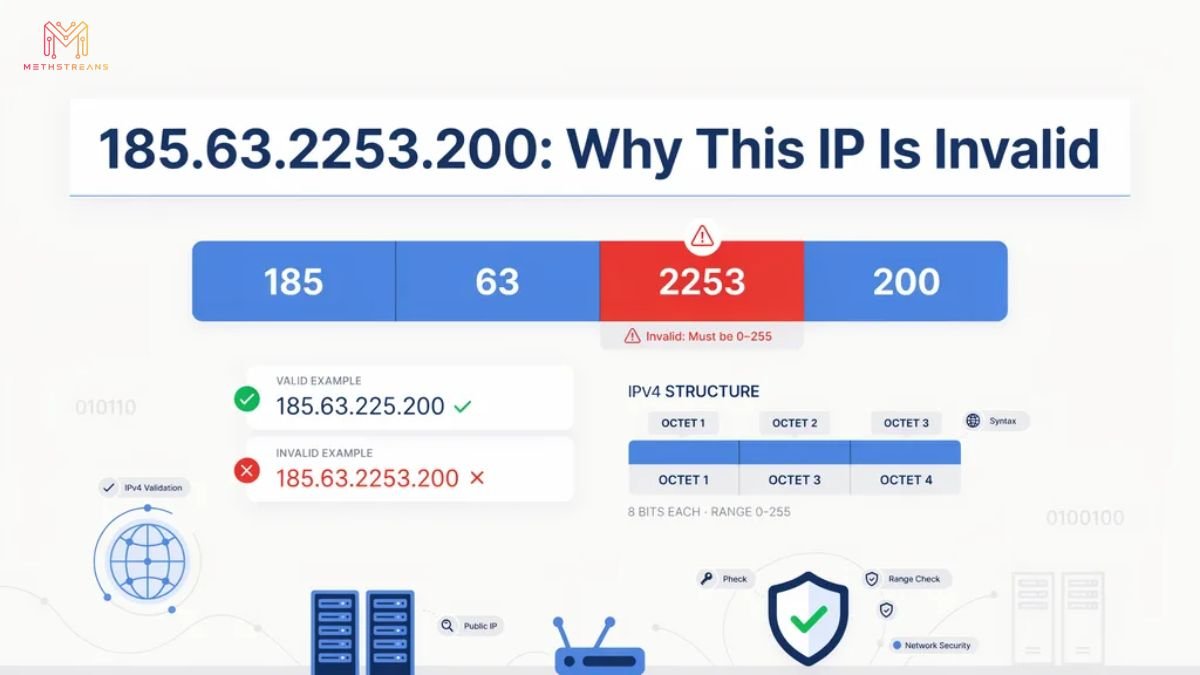
No. A real IPv4 address always has four numeric segments called octets, each separated by a dot, and each octet must fall between 0 and 255. In 185.63.2253.200, the third segment — 2253 — breaks that rule. No device, router, DNS record, or firewall rule can treat this as a routable address because it violates the basic syntax of IPv4.
Why Are People Searching for This IP Address?
Most searches for a malformed IP like this come from one of a few situations: someone saw it in a server log and wants to know if it’s a threat, a script generated it accidentally due to a bug, a typo happened while manually entering a network setting, or it appeared in spam/phishing content designed to look technical. Understanding the structure of IPv4 addresses clears up the confusion instantly.
Quick Answer
185.63.2253.200 is invalid because the octet “2253” exceeds the maximum allowed value of 255 for any segment of an IPv4 address. It cannot be assigned to a device, pinged, or used in any legitimate network configuration.
Understanding IPv4 Address Structure
What Is an IPv4 Address?
An IPv4 (Internet Protocol version 4) address is a unique numerical label assigned to a device on a network so it can send and receive data. It is the addressing system that has powered the internet since the 1980s, and despite the rise of IPv6, IPv4 still handles a huge share of global internet traffic.
How IPv4 Addresses Are Formed
Every IPv4 address is a 32-bit number, split into four 8-bit sections called octets. Each octet is written in decimal form and separated by periods — for example, 192.168.1.1. Since each octet is 8 bits, it can represent values from 0 to 255 (because 2^8 = 256 possible combinations, starting at zero).
Valid Range for Each Octet
- Minimum value per octet: 0
- Maximum value per octet: 255
- Total possible addresses: roughly 4.3 billion (2^32)
Any number outside 0–255 in any position — like 2253 — automatically disqualifies the entire string as a valid IPv4 address, regardless of how the other three octets look.
Public vs Private IP Addresses
Valid IPv4 addresses are further split into public and private ranges. Private ranges (like 192.168.0.0–192.168.255.255, 10.0.0.0–10.255.255.255, and 172.16.0.0–172.31.255.255) are reserved for internal networks such as home routers and office LANs. Public IPs are unique, globally routable internet addresses. An invalid address like 185.63.2253.200 doesn’t qualify as either, because it fails validation before range classification even matters.
Why 185.63.2253.200 Is an Invalid IP Address
Which Octet Makes the Address Invalid?
Breaking the address into its four parts: 185, 63, 2253, 200. The first, second, and fourth octets (185, 63, 200) are all within the legal 0–255 range. The third octet, 2253, is the problem — it’s nearly nine times larger than the maximum allowed value.
Why an Octet Cannot Exceed 255
This limit isn’t arbitrary — it comes directly from binary math. Each octet stores exactly 8 bits, and 8 bits can only represent 256 unique values (0 through 255). To represent 2253, you’d need at least 12 bits, which breaks the fixed 32-bit structure that IPv4 depends on for consistent addressing and routing.
Technical Explanation of the Validation Error
When software attempts to parse 185.63.2253.200, most IP-handling libraries throw an error like “invalid literal for IPv4 address” or “value out of range.” This happens because parsers convert each octet into an 8-bit binary value; when a number can’t fit into 8 bits without overflow, the conversion fails and the entire address is rejected.
How IP Address Validation Works
Syntax Validation
The first check is structural: does the string have exactly four segments separated by three dots, with no letters, extra symbols, or missing parts? 185.63.2253.200 passes this superficial check since it has four dot-separated groups — which is exactly why the error can be confusing at first.
Range Validation
The second, more important check verifies that each segment’s numeric value sits between 0 and 255. This is where 185.63.2253.200 fails, since 2253 is far outside the permitted range.
Network-Level Validation
Even addresses that pass syntax and range checks may still be rejected at the network level if they fall into reserved, loopback, multicast, or unassigned ranges. Network-level validation matters for real IPs, but it’s irrelevant here since the address fails at the more basic range-validation stage.
Manual vs Automated Validation
Manually checking an IP means visually scanning each octet — doable but error-prone with long lists. Automated validation using scripts, regular expressions, or built-in libraries is faster, catches subtle mistakes, and scales to thousands of entries, which is why most production systems rely on code-based validation instead of manual review.
Common Causes of Invalid IP Addresses
Typographical Mistakes
A simple typo — hitting an extra key or transposing digits — can turn 225 into 2253 or 22.53. Fast typing or unclear input fields make this one of the most frequent causes of invalid IPs.
Incorrect Network Configuration
Admins manually entering static IPs, subnet masks, or gateway addresses sometimes enter malformed values, especially when copying configurations between devices with different formatting standards.
Software or Script Errors
Bugs in scripts that generate or concatenate IP addresses — such as improperly formatted loops, string concatenation errors, or misconfigured IP-range generators — can output impossible values like octets above 255.
Copy-and-Paste Mistakes
Copying an IP from a document, spreadsheet, or webpage sometimes pulls in extra characters or merges two separate numbers together, producing something that looks like an IP but isn’t one.
How to Verify an IP Address
Using Online IP Validators
Free online IP validation tools let you paste an address and instantly see whether it’s syntactically correct, within range, and whether it belongs to a public or private block.
Using Command-Line Tools
Commands like ping, nslookup, or traceroute will return clear errors when given an invalid address, since the operating system’s network stack rejects malformed input before attempting any connection.
Validating with Programming Languages
Languages like Python offer built-in modules (such as ipaddress) specifically for validating and manipulating IP addresses, making it easy to catch invalid values programmatically.
Browser-Based Validation Tools
Many network utility websites offer instant, in-browser validation with visual feedback, useful for quick manual checks without installing anything.
Common IP Address Validation Tools
Online Validation Websites
Dedicated IP-checking sites instantly flag malformed addresses and often show geolocation or ownership data for valid ones.
Network Diagnostic Utilities
Tools bundled with operating systems — ipconfig, ifconfig, ping, and traceroute — are the most direct way to test real connectivity and catch invalid entries early.
Programming Libraries
Libraries such as Python’s ipaddress, PHP’s filter_var(), and JavaScript’s net module (Node.js) or regex-based checks handle validation reliably inside applications.
Enterprise Network Monitoring Tools
Larger organizations use SIEM and network monitoring platforms that automatically flag malformed or suspicious IPs in logs, helping security teams catch configuration errors or spoofing attempts at scale.
IPv4 vs IPv6: Key Differences
Address Format Comparison
IPv4 uses four decimal octets (e.g., 185.63.14.200), while IPv6 uses eight groups of hexadecimal digits separated by colons (e.g., 2001:0db8::1), allowing far more complex and longer addresses.
Address Capacity
IPv4 supports about 4.3 billion unique addresses, while IPv6 supports an almost unimaginable 340 undecillion addresses, solving the IPv4 exhaustion problem that has driven global adoption of the newer standard.
Security Features
IPv6 was designed with built-in support for IPsec, offering more consistent encryption and authentication options compared to IPv4, which added these features later as optional extensions.
Performance and Compatibility
IPv4 remains more universally compatible with older hardware and software, while IPv6 offers more efficient routing and eliminates the need for NAT (Network Address Translation) in most cases — though dual-stack support is still common during the transition period.
Security Risks of Invalid IP Addresses
Firewall Configuration Problems
Entering an invalid IP into firewall rules can cause the rule to silently fail, potentially leaving a gap in protection or blocking legitimate traffic due to a misconfigured entry.
Access Control Errors
Access control lists relying on malformed IPs may behave unpredictably, sometimes granting or denying access incorrectly, which can create real security exposure.
Logging and Monitoring Issues
If logging systems record invalid IPs from spoofed headers or corrupted data, it can distort analytics, mask the true source of traffic, and interfere with threat detection.
API and Application Failures
Applications that accept user-submitted IP addresses without proper validation risk crashes, unexpected behavior, or even injection-style exploits if malformed input isn’t handled safely.
Real-World Examples of Invalid IP Addresses
Common Invalid IPv4 Examples
Examples of invalid addresses include 999.1.1.1, 10.10.10.999, 300.168.1.1, and of course 185.63.2253.200 — all share the same core flaw of at least one octet exceeding 255.
Common Formatting Errors
Other frequent mistakes include missing octets (192.168.1), extra octets (192.168.1.1.1), leading zeros interpreted incorrectly, or using commas instead of dots.
Mistakes Made by Beginners
New network administrators often confuse subnet masks with IP addresses, misplace decimal points, or forget that private ranges can’t be used for public-facing services — all separate issues from outright invalid syntax but equally disruptive.
How Developers Validate IP Addresses in Code
Python Validation
Python’s built-in ipaddress module can validate an address with a simple try/except block, immediately raising a ValueError for something like 185.63.2253.200.
PHP Validation
PHP developers commonly use filter_var($ip, FILTER_VALIDATE_IP), which returns false for any malformed address, making it easy to reject bad input before processing.
JavaScript Validation
In JavaScript, developers either write a regex pattern checking each octet’s range or use Node.js’s built-in net.isIP() function for a fast, reliable check.
Regular Expressions vs Built-in Libraries
While regex can validate IPv4 format, well-tested built-in libraries are generally safer and less error-prone than hand-written patterns, since libraries already account for edge cases like leading zeros and IPv6-mapped addresses.
Best Practices for IP Address Validation
Validate Input Before Processing
Always validate IP addresses at the point of entry — whether from a form, API request, or config file — before passing them further into your system.
Use Trusted Validation Libraries
Rely on established libraries rather than custom regex where possible, since they’re maintained, tested, and updated for edge cases.
Sanitize User Input
Strip whitespace, hidden characters, and unexpected symbols before validation to avoid false negatives caused by formatting noise rather than genuine invalid values.
Monitor Invalid IP Logs
Regularly review logs for recurring invalid IP entries, since a pattern of similar errors can point to a bug, misconfiguration, or malicious probing attempt.
Keep Network Software Updated
Outdated network tools and libraries may have looser validation logic or known bugs; keeping software current reduces the risk of invalid addresses slipping through unnoticed.
FAQs
Can an IPv4 Address Contain 2253?
No single octet in an IPv4 address can contain the value 2253, since every octet is limited to 8 bits and must fall between 0 and 255. The number 2253 could only appear as part of an IPv6 hextet or in an unrelated context, never as a valid IPv4 segment.
What Is the Maximum IPv4 Octet Value?
The maximum value any IPv4 octet can hold is 255, because each octet is an 8-bit binary number and 8 bits can represent at most 256 distinct values, starting from zero.
Is 185.63.2253.200 Dangerous?
By itself, this string isn’t dangerous — it’s simply broken and unusable by any real network device. If you encountered it in a log file or email, it’s more likely the result of a typo, a scraping bug, or spoofed/randomly generated data than an actual live threat, though it’s always wise to review the surrounding context for genuine suspicious activity.
Can an Invalid IP Address Cause Errors?
Yes, definitely. Feeding an invalid IP into a firewall, application, script, or network device can trigger crashes, silent rule failures, broken API calls, or misleading log entries, depending on how that specific system handles bad input.
How Do I Correct an Invalid IP Address?
Start by checking each octet against the 0–255 range, correcting any typos, and confirming the address has exactly four segments separated by three dots. If you’re unsure of the original intended address, cross-check it against the source document, configuration backup, or the device it’s supposed to belong to.
Conclusion
185.63.2253.200 is a useful example of exactly how IPv4 validation breaks down: three valid-looking octets can’t save an address if even one segment — like 2253 — exceeds the 255 limit built into the protocol’s 8-bit structure.Whether you’re a beginner or a developer, understanding this rule helps prevent configuration errors, security risks, and application issues. bugs down the line.
Key Takeaways
Every IPv4 address has four octets, each strictly limited to 0–255. Values like 2253 break this rule instantly, regardless of the rest of the address. Validation should happen at multiple levels — syntax, range, and network context — using trusted libraries rather than manual checks alone. Most invalid IPs trace back to typos, script bugs, or copy-paste errors rather than anything malicious.
Final Thoughts
As IPv6 adoption grows and networks become more complex, understanding foundational IPv4 rules remains essential groundwork. Keep validation tools updated, sanitize input early, and treat any malformed address — like 185.63.2253.200 — as a signal to double-check your data rather than a real network destination. Future updates to this guide will track evolving validation standards, new tooling, and emerging IPv6 transition practices as they become relevant.